
 MikroWizard
The Next Era of Network Infrastructure Management: How MikroWizard Evolved from a Dedicated RouterOS Management Tool into an Enterprise-Grade Zero-Trust PAM & Multi-Vendor Control Plane.
1. The Paradigm Shift in Network Operations
When MikroWizard v1 was originally introduced, its primary mission was solving operational efficiency: helping network administrators automate RouterOS backups, push bulk configuration scripts, monitor system health, and orchestrate firmware updates across fleets of MikroTik routers from a centralized web interface.
However, modern enterprise networks and Internet Service Providers (WISPs, MSPs, Data Centers) have faced a rapid transformation in compliance, cybersecurity, and infrastructure complexity. Traditional network management tools that merely log actions after they occur or grant unrestricted, unmonitored SSH/WinBox access are no longer sufficient to meet strict zero-trust mandates (such as ISO 27001, SOC2, and NIS2).
MikroWizard v2 represents a complete architectural reimagining. We redesigned the underlying database schema, rewritten the cryptographic engine from the ground up, and introduced full Privileged Access Management (PAM) with pre-execution command guardrails, audited visual session recording, and seamless multi-vendor fleet governance.

2. Zero-Trust Terminal Gateway & Command Guardrails
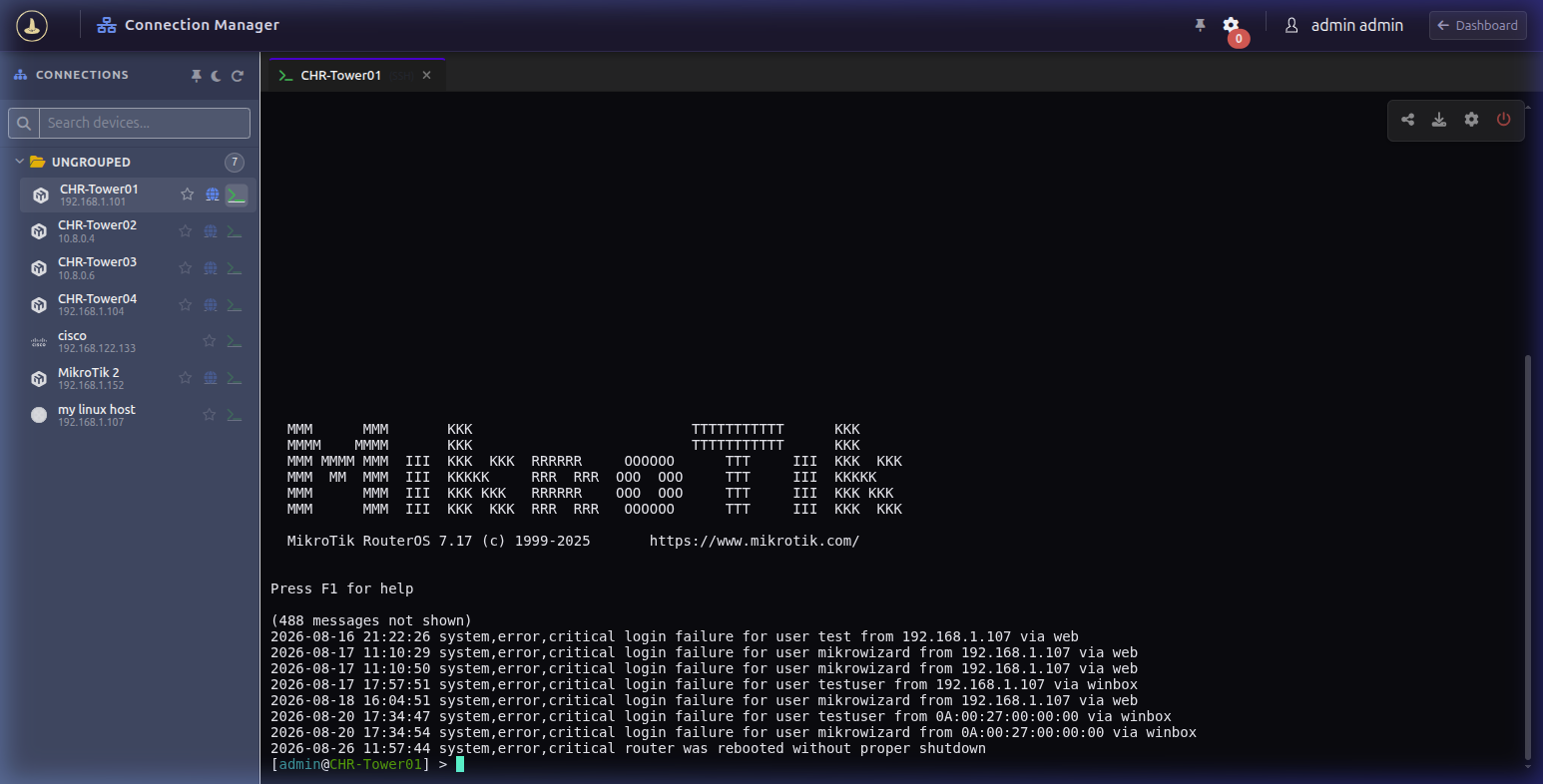
The centerpiece of MikroWizard v2 is the high-performance Terminal Gateway. Built with a responsive xterm.js Web TTY architecture, it delivers a native, colorized terminal experience directly in your browser while evaluating every keystroke through a zero-trust policy engine.
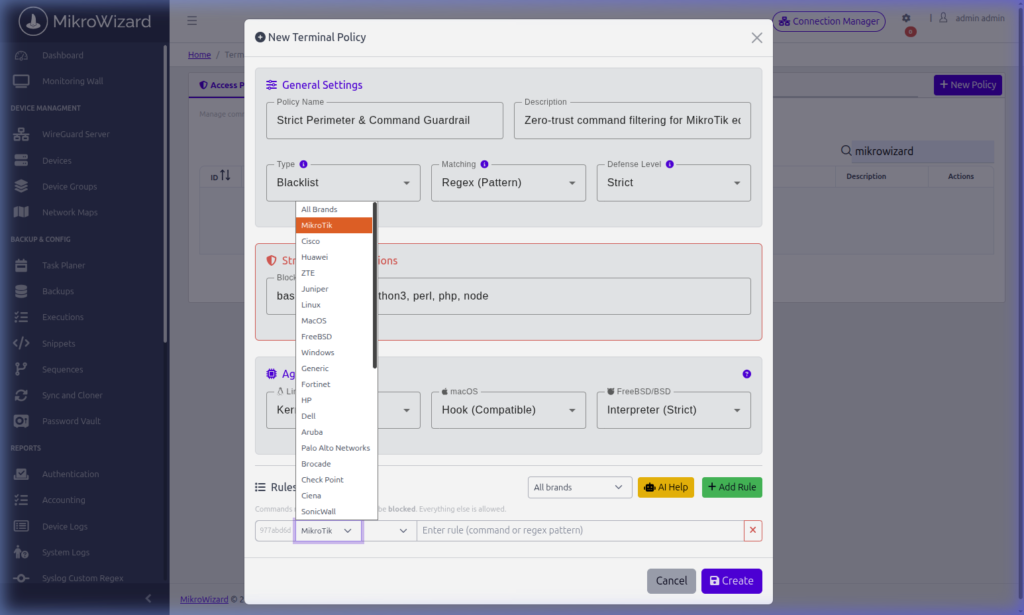
- Pre-Execution Command Interception: Instead of recording commands retroactively, the policy engine parses and analyzes command tokens and Abstract Syntax Trees (AST) before sending them to the router or host shell.
- Three-Tier Defense Heuristics:
- Relaxed Tier: Evaluates token and regular expression rules without subshell filtering.
- Standard Tier: Detects and blocks command substitution attempts such as
$(command)and backticks (`command`). - Strict Tier: Blocks command chaining (
&&,||,;), parameter expansions (${VAR}), base64 decoder pipes (base64 -d | sh),/dev/tcpraw sockets, and enforces kernel-level system-call interception (ptrace/seccomp-bpfonexecve) for Linux nodes.
- Blacklist, Whitelist & Auto-Execute Policies: Prevent accidental catastrophe (e.g. blocking
/system reset-configurationorrm -rf /) or lock down contractor access strictly to read-only diagnostics. - Full Asciinema Session Recording: Every session is recorded in
.castformat with millisecond timing for forensic auditing and training reviews.
3. Audited WebFig Proxy & Visual Session Recorder
Historically, accessing MikroTik WebFig remotely required opening HTTP/HTTPS ports to public subnets, establishing complex port forwardings, or configuring dedicated desktop VPN clients. In MikroWizard v2, WebFig access is transformed into a secure, audited enterprise feature:
- Zero Exposed Ports: WebFig traffic is proxied through an encrypted WebSocket/HTTP reverse tunnel. Routers remain completely hidden from port scanners.
- Automated Vault Login: Administrators authenticate via MikroWizard; device credentials remain securely vaulted and are never exposed to operators.
- DOM & Visual Session Recording: Every tab opened, setting changed, and button clicked within WebFig is visually recorded with timestamps for compliance.
- Collaborative Live Sessions: Share active WebFig sessions between team members in real-time with role-based permissions (
Owner,Collaborator, and read-onlyObserver).

4. Cryptographic Overhaul & Secure Vault Architecture
Data security was rebuilt from the foundation in MikroWizard v2. The legacy storage model was replaced with a zero-knowledge Envelope Encryption Vault:
- Envelope Encryption: every credential (passwords, SSH private keys, passphrases) is encrypted with its own data key, which is wrapped by a master key.
- Full End-to-End API SSL (Port 8729): Native support for TLS-encrypted RouterOS API (API-SSL) communication with certificate fingerprint validation.

5. Expanding Beyond MikroTik: True Multi-Vendor Support
While MikroTik RouterOS remains the beating heart of MikroWizard, real-world network topographies are heterogeneous. In v2, the platform seamlessly manages multi-vendor fleets:
- Supported Platforms: MikroTik RouterOS (v6 & v7), Linux Hosts (Ubuntu, Debian, RHEL), Cisco IOS / IOS-XE, Huawei VRP, Juniper Junos, Fortinet FortiOS, ZTE, FreeBSD, and Generic SSH targets.
- Template-Driven Connection Engine: Integrated with standard connection templates (including
rConfigtemplates) for automated CLI prompt navigation and privilege escalation (enable/supermode). - Unified Policy Enforcement: Apply standardized command guardrails, audit logging, and role-based access controls across all network assets from a single console.

6. WireGuard Mesh, CGNAT Bypass & Automated Speedtests
MikroWizard v2 introduces several dedicated features engineered specifically for Internet Service Providers and remote site management:
- Built-in WireGuard Peering Mesh: Automatically provisions WireGuard VPN tunnels to connect field routers located behind strict Carrier-Grade NAT (CGNAT) or dynamic LTE/5G uplinks back to the management cluster.
- Automated BTest / Speedtest Engine: Schedule automated, non-intrusive Bandwidth Tests between CHR core servers and customer routers. Track latency, jitter, throughput graphs, and store raw telemetry.
- Custom Syslog Regex Alerts: Create custom regex patterns to filter incoming syslog streams and dispatch real-time alerts to Telegram, Webhooks, or Email upon critical network events (BGP state changes, flap detection, interface errors).
7. Feature Comparison Matrix: v1 vs v2
| Core Capability | MikroWizard v1 | MikroWizard v2 |
|---|---|---|
| Terminal Access | Basic unmonitored SSH | Zero-Trust Web TTY + PAM Guardrails |
| Command Defense | None (Post-execution logs) | 3-Tier Defense (Token, Regex, AST Parser & Kernel ptrace) |
| WebFig Access | Direct / Exposed Ports | Audited WebSocket Reverse Proxy + Visual Session Recording |
| Credential Storage | Basic reversible encryption | Per-credential envelope encryption |
| Multi-Vendor Support | MikroTik RouterOS only | MikroTik + Cisco + Linux + Huawei + Juniper + FreeBSD |
| NAT / CGNAT Reachability | Requires public IP / manual VPN | Built-in Automated WireGuard Mesh Peering |
| Diagnostics & Testing | Manual ping/traceroute | Automated BTest (MikroSpeed) Telemetry & Custom Syslog Alerts |
| Architecture & UI | Monolithic stack | Containerized Microservices + Angular 18 + PrimeNG |
8. Get Started with MikroWizard v2 Today
Whether you manage a small network of MikroTik routers or an expansive multi-vendor service provider infrastructure, MikroWizard v2 delivers the security, visibility, and automation required for modern network operations.